

The Military AI Landscape in 2026: From Hardware to Software
Written by Ninor Amir, David Kakanis & Jesse Weltevreden
What does the military AI landscape actually look like? Drawing on data from 519 companies across 12 categories, this analysis examines where investment is flowing, which regions are leading, and why software, intelligence and coordination capabilities are becoming increasingly important.
Military AI is changing rapidly. While drones, robots and autonomous systems attract most of the public attention, much of the innovation is happening in software.
AI is increasingly used to process intelligence, combine sensor data, coordinate autonomous systems, detect cyber threats and support battlefield decision-making. In many cases, the value lies not in the hardware itself, but in the software that enables it.
Military AI has become one of the fastest-growing segments of the AI industry. Estimates from Grand View Research and The Business Research Company suggest the global military AI market was worth around $10–11 billion in 2024 and 2025, with forecasts ranging from approximately $19 billion by 2030 to more than $60 billion by 2034. Governments are playing a central role in this growth. In January 2026, the United States issued a policy memorandum aimed at accelerating military AI development, while the Pentagon awarded contracts worth up to $200 million each to Anthropic, Google, OpenAI and xAI.
But budgets alone do not explain how the industry is evolving. To understand that, we need to look at the companies building these technologies.
In short
- RankmyAI tracks 12 categories, from drones and counter-drone systems to intelligence software, cyber defense and battlefield coordination. The 519 companies fall into three broad segments: physical platforms, software, and supportive systems.
- Funding is significantly more concentrated than company presence. While North America represents about half of the companies included in the analysis, it accounts for nearly 80% of recorded capital. Europe has made greater progress in expanding its company base than in closing the investment gap.
- Half the industry is younger than ten years. The median company was founded in 2015, and the newest category, multi-domain coordination, barely existed before 2020. Yet, the same data also contain defense companies founded in the 1800s.
The defense industry in the age of AI
Military AI encompasses a wide range of technologies and applications. It includes autonomous aerial, ground and naval systems, intelligence and surveillance platforms, cyber defense solutions, predictive maintenance systems, battlefield coordination software, and tools that support soldier performance and training.
What these technologies have in common is the use of AI to process large volumes of data, identify patterns, generate insights and support decision-making. Whether the objective is detecting incoming threats, analyzing satellite imagery, coordinating autonomous systems or predicting equipment failures, AI is increasingly being used to improve the speed, accuracy and scale of military operations.
How we mapped it: 519 tools, 12 categories, three segments
At RankmyAI, we track 519 AI companies across 12 military and defense categories: ISR (intelligence, surveillance and reconnaissance), drones (UAVs), counter-UAS, ground robots (UGVs), naval uncrewed systems (USV/UUV), humanoid and quadruped robots, space and geospatial intelligence, multi-domain coordination, cyber defense, simulation and wargaming, predictive maintenance, and soldier performance.
Although military AI covers a wide range of technologies, the categories can be grouped into three broader segments: physical platforms, software and intelligence systems, and supportive systems.
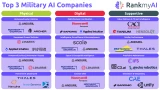
- Physical platforms: autonomous and semi-autonomous systems operating in the air, on land and at sea, including UAVs (Shield AI), counter-UAS systems (CHAOS Industries), ground robots (Forterra), uncrewed vessels (Saronic Technologies), and humanoid and quadruped robots (Boston Dynamics). This segment comprises 332 companies.
- Software and digital systems: technologies that collect, process and act on information, including ISR (Palantir), space and geospatial intelligence (ICEYE), cyber defense (CrowdStrike), simulation and wargaming (Unity), multi-domain coordination (Anduril), and predictive maintenance (Gecko Robotics). This segment comprises 347 companies.
- Supportive and enabling systems: technologies that support personnel, readiness and operational effectiveness, including soldier performance, training and health-monitoring solutions (Elbit Systems). This segment comprises 31 companies.
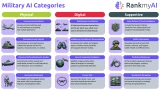
The segments are not mutually exclusive. Many companies operate across multiple categories. For example, a drone company may also develop ISR capabilities by processing and analysing surveillance data collected by its own platforms. As a result, 49% of the companies in the dataset are active in more than one category, with companies appearing in an average of approximately two categories.
The shape of the field: ISR is everywhere
The largest category in the dataset is ISR (intelligence, surveillance and reconnaissance), with 243 companies, making it more than twice the size of the next largest category. This reflects the central role of intelligence gathering, data processing and situational awareness within modern military operations.
The importance of ISR is also evident in its strong overlap with other categories. The largest overlap in the dataset is between UAVs and ISR, with 110 companies active in both categories. Many drone companies not only develop autonomous platforms, but also provide capabilities for collecting, processing and analyzing intelligence data. Similar overlaps can be observed between ISR and counter-UAS systems, naval autonomous systems, and space and geospatial intelligence.
These findings suggest that intelligence capabilities increasingly form a foundational layer across the military AI ecosystem, supporting a wide range of platforms and applications.
After ISR, the largest categories are UAVs (209 companies) and counter-UAS systems (100 companies), reflecting the growing importance of autonomous systems and counter-drone technologies within modern defense operations. At the other end of the spectrum, humanoid and quadruped robots remain the smallest category, with just 10 companies represented in the dataset.
One of the clearest patterns in the data is the age distribution across categories. Multi-domain coordination is by far the youngest category, with a median founding year of 2020. More than half of the companies in this category were founded in 2020 or later. These companies focus on integrating and coordinating multiple autonomous systems, sensors and platforms within a shared operational environment.
Counter-UAS is another relatively young category, reflecting the rapid growth of technologies designed to detect, track and neutralize unmanned aerial systems. Together, these patterns suggest that innovation in military AI is increasingly focused on coordination, integration and autonomy, rather than on individual platforms alone.
The hardware layer: autonomous systems at scale
Across the hardware categories, the emphasis is increasingly shifting towards affordability, scalability and attrition tolerance. Recent conflicts have demonstrated the strategic value of deploying large numbers of relatively inexpensive autonomous systems, particularly drones, rather than relying exclusively on a small number of costly platforms.
Nowhere is this trend more visible than in Ukraine. In our rankings, Ukraine emerges as a distinct military AI cluster with a median founding year of 2022, reflecting the rapid growth of defense technology companies since the start of the war. Even this likely understates the size of the ecosystem. The government-backed Brave1 initiative coordinates more than 200 companies developing AI-enabled drones, while the Ministry of Defense plans to contract 25,000 uncrewed ground vehicles within a six-month period and expand the use of machine vision across frontline drones.
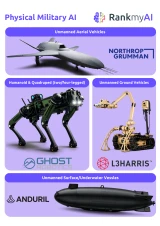
Similar developments can be observed across the broader hardware landscape. Companies such as Shield AI develop autonomous aircrafts capable of operating in environments where GPS and communications are disrupted. The growing use of drones has also accelerated the development of counter-UAS technologies, with companies such as CHAOS Industries focusing on the detection and interception of unmanned systems. Meanwhile, companies such as Forterra deploy autonomous ground vehicles for logistics and route clearance, while Boston Dynamics represents a small but emerging category of humanoid and quadruped robotic systems.
Taken together, these developments point to a hardware landscape characterized by increasing autonomy, greater operational scale and the growing integration of AI into physical systems.
The software layer: intelligence, coordination and decision support
A growing share of military AI activity is concentrated in software systems that collect, process and act on information. These technologies support intelligence gathering, situational awareness, operational coordination and decision-making across a wide range of military applications.
One important category is decision-support systems (DSS). Rather than operating autonomously, these systems analyze large volumes of data from sensors, intelligence sources and operational systems to generate recommendations for human operators. Such systems are already being deployed in operational settings. Israel's military has reportedly used decision-support tools including "The Gospel," which identifies structures as potential targets, and "Lavender," which reportedly scored individuals based on suspected affiliations.
The increasing importance of software is also reflected in the growth of multi-domain coordination, the youngest category in our dataset. These systems are designed to integrate data, sensors and autonomous assets into a shared operational picture. Anduril's Lattice platform is one of the best-known examples. Closely related is the cyber defense category, where companies such as CrowdStrike focus on protecting the digital infrastructure that modern military operations increasingly depend upon. Europe's most valuable defense startup, Helsing, initially built its position around battlefield data fusion and decision-support software before expanding into autonomous systems.
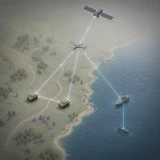
Within our dataset, these capabilities are primarily represented by the ISR, multi-domain coordination and cyber defense categories. Notably, these are also among the fastest-growing and best-funded segments of the military AI landscape, highlighting the increasing strategic importance of software, intelligence and coordination capabilities.
Investment patterns
Across the dataset, we identified approximately $122 billion in recorded capital associated with companies active in military AI. Funding data is available for 282 of the 519 companies included in the analysis.
The median funded company has raised approximately $43 million, indicating that much of the sector consists of small and medium-sized companies rather than a limited number of large technology firms. At the same time, investment is distributed unevenly across categories.
The highest median funding levels are found in cyber defense ($197 million per funded company), space and geospatial intelligence ($136 million), and soldier performance ($116 million). In contrast, the UAV and counter-UAS categories are characterized by a larger number of companies with lower median funding levels. At the segment level, software and intelligence systems account for the largest share of recorded capital ($107 billion), substantially exceeding physical platforms (approximately $65 billion).
These findings suggest that investors place particular value on technologies that collect, process and act on information, including cyber defense, intelligence and decision-support capabilities. This pattern aligns with the broader shift observed throughout the military AI landscape, where software and intelligence capabilities are becoming increasingly important alongside physical systems.
The funding figures presented here should not be compared directly with estimates of the military AI market discussed earlier in this article. While market estimates aim to measure the value of military AI products and services, our funding data reflects total recorded capital associated with companies active in military AI. Many companies in the dataset operate across a broad range of defense and aerospace markets, including aircraft, naval systems, missiles, munitions, communications infrastructure and other military technologies. In addition, several companies are large diversified defense contractors whose activities extend well beyond AI. As a result, the funding figures should be interpreted primarily as indicators of company scale, financial resources and investment capacity rather than direct measures of investment in military AI technologies.
The geography of military AI
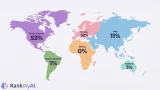
Military AI activity is highly concentrated geographically. North America accounts for 275 companies in the dataset and approximately $101 billion in recorded funding, representing around four-fifths of all recorded capital. The United States alone accounts for 260 companies, approximately half of the global total, and is home to many of the sector's most prominent companies, including Anduril, Palantir, Scale AI, Northrop Grumman and L3Harris.
Europe ranks second with 169 companies, led by the United Kingdom (34), France (20) and Germany (18). However, with approximately $14 billion in recorded funding, Europe remains well behind North America in terms of capital. Recent developments nevertheless suggest growing investor interest in the region. Munich-based Helsing was valued at €12 billion in 2025 following a €600 million funding round led by Daniel Ek's investment vehicle. By May 2026, the company was reportedly raising an additional $1.2 billion at a valuation of approximately $18 billion, positioning it among the most highly valued defense technology companies globally.
Asia (57 companies) and Oceania (15 companies) account for a smaller share of the visible ecosystem, with South Korea, India and Australia emerging as notable centers of activity. However, these figures should be interpreted with caution. Our methodology relies primarily on publicly accessible information, funding records and media reporting, which are less effective at capturing state-linked, closed or less transparent ecosystems. As a result, countries such as China and, to a lesser extent, Russia are likely underrepresented in the dataset despite their widely recognized investments in military AI. Similar limitations apply in Ukraine, where security considerations associated with the ongoing war often discourage companies from publicly disclosing detailed information about their activities, locations or funding. Consequently, the actual scale of military AI activity in these countries is likely larger than reflected in our dataset.
Established defense companies and new entrants
The military AI landscape brings together some of the world's oldest defense companies and a new generation of AI-focused firms. The oldest company in our dataset, Kongsberg Maritime, was founded in 1814, followed by Rheinmetall (1889), Thales (1893) and L3Harris (1895). These companies now appear alongside recently founded startups as they increasingly incorporate AI into existing defense technologies and systems.
At the same time, the sector remains relatively young. The median company in the dataset was founded in 2015, while approximately 30% of companies were established in 2020 or later. Company sizes also tend to be modest, with firms employing 11 to 50 people representing the largest group, followed by companies with 51 to 200 employees.
Together, these figures illustrate a military AI ecosystem that combines established defense contractors with a rapidly growing population of specialized AI companies.
Governance and ethical questions
As decision-support systems and autonomous technologies become more widely used in military operations, questions about oversight, accountability and human control have become increasingly important. Governments, researchers and international organizations continue to debate where human judgment should remain essential and how autonomous systems should be governed.
These discussions are no longer theoretical. In early 2026, the U.S. Defense Secretary publicly urged Anthropic to reconsider restrictions on military applications of its AI. Anthropic maintained two prohibitions: fully autonomous targeting and domestic mass surveillance. At the same time, organizations such as SIPRI and the United Nations are working to develop frameworks and principles for the responsible use of AI in military contexts.
RankmyAI does not take a position in these debates. Our role is to make the military AI landscape more transparent by providing data on the companies, technologies and trends shaping the sector. The purpose of this analysis is not to determine how military AI should be governed, but to provide a clearer picture of what is being developed and where activity is taking place.
Methodology
This analysis is based on RankmyAI's military and defense rankings, comprising 519 companies across 12 categories as captured in our April 2026 dataset. Funding data reflects information available at the time of data collection and is based on an 18-month tracking window.
The rankings focus on companies with measurable market presence and publicly available information. As with all RankmyAI analyses, the results should be interpreted as a representation of the observable ecosystem rather than a complete inventory of all military AI activity.
Every company referenced in this article has a dedicated profile page in our rankings. Readers can explore the rankings, review the methodology, or submit corrections and additions through the links below.
- All rankings: https://www.rankmyai.com/rankings
- Methodology: https://www.rankmyai.com/about-us/methodology
- Add or edit a company: https://www.rankmyai.com/tool-addition


