


Lead Generation: The Most Popular AI Solutions for Finding New Customers
Written by David Kakanis

AI lead generation tools automate prospecting, enrichment, and outreach at scale. These are the most popular platforms right now, the European alternatives, and the trade-offs worth checking before you commit.
This article was originally published in Dutch on Marketingfacts, as part of the recurring column by Marketingfacts and RankmyAI. The analysis is based on RankmyAI data from June 2026.
AI is finding increasingly concrete applications in marketing, but the number of tools is growing so fast that keeping track is becoming a challenge. In this recurring column, Marketingfacts and RankmyAI spotlight an AI application relevant to marketers every two weeks. This edition we explore lead generation: tools that help businesses identify, attract, and qualify potential customers through automated prospecting, data enrichment, and personalized outreach.
In brief
- AI lead generation tools automate prospecting, outreach, and lead qualification at scale.
- Tools differ in focus, from data enrichment to conversational engagement to quiz marketing.
- Match your choice to your sales workflow, channels, and integration needs.
What does AI bring to lead generation?
Traditional lead generation relies heavily on manual research, cold calling, and broad campaigns that often miss the mark. AI changes this by analyzing vast amounts of data to identify high-potential prospects, personalize outreach messages, and score leads based on likelihood to convert.
The result is a more efficient pipeline. Marketing and sales teams spend less time on unqualified contacts and more time on conversations that matter, while AI handles the repetitive work of finding, enriching, and prioritizing leads.
What to look for when choosing?
When choosing a lead generation tool, a few factors make all the difference. The most important distinction is whether you need a tool focused on data enrichment and prospecting, one that handles outreach automation, or a platform that combines both. Integration with your existing CRM and communication channels is equally critical, as a tool that does not fit your workflow will create friction rather than efficiency.
Beyond core functionality, consider the pricing model carefully. Some tools charge per lead or per contact enriched, while others offer flat subscriptions. Data privacy and compliance deserve attention too, especially when operating in regulated markets. Finally, evaluate how much control you retain over messaging and targeting, since over-automation can hurt brand trust.
The market in numbers
Exactly how many lead generation tools exist worldwide is difficult to determine given the rapid growth of AI applications. Within RankmyAI we track 520 relevant players with sufficient data coverage. Based on their website traffic, the market is fragmented: the top 10 tools account for approximately 33% of total traffic.
Looking at founding years, the market is relatively young: most tools were founded after 2017 and are less than 9 years old. 64% were founded after 2020. Geographically, the largest share comes from the United States at around 30%, followed by the United Kingdom (5%) and Brazil (5%). Europe is represented with 119 tools (23%).
Top 10 lead generation
The table below shows the top 10 lead generation tools based on a combination of website traffic, investment, and user reviews.
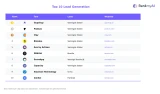
Notable: Ava by Artisan, founded in 2023, is the youngest tool in the top 10, signaling strong market momentum for AI-native sales agents.
European alternatives
Looking for a European alternative for privacy or regulatory reasons? Here are 3 popular options.
ScoreApp (United Kingdom) uses AI-powered quiz marketing to generate warm, pre-qualified leads. lemlist (France) specializes in multichannel cold outreach with AI-driven personalization and CRM integration. Linkfinder AI (France) focuses on data enrichment, gathering comprehensive company information from multiple sources using advanced algorithms.
It is worth noting that a European origin does not mean these tools avoid technology or AI models from outside the EU.
Most popular use cases
Based on RankmyAI data, a number of use cases consistently stand out.
- Automated outbound prospecting, where AI identifies and contacts potential leads at scale, including Clay and Ava by Artisan. Both also offer broader sales workflow automation beyond prospecting alone.
- Conversational lead capture through chatbots and messaging, such as Gupshup and Capacity. These platforms also serve customer support functions.
- Multichannel campaign outreach combining email, social, and other channels, for example lemlist and ZENVIA.
- Lead qualification and scoring to prioritize the most promising contacts, among others Podium and ScoreApp.
- Event-driven lead generation using registration and engagement data, as offered by Bizzabo and Xiaoman Technology.
Why use AI for lead generation?
AI-powered lead generation saves significant time by automating the most labor-intensive parts of the sales funnel. Instead of manually searching for prospects and crafting individual messages, teams can focus on building relationships with pre-qualified leads.
For marketers looking to scale their pipeline without scaling their team, these tools offer a practical starting point. Start with one use case, measure results, and expand from there.
About the data
The analysis in this article is based on data from RankmyAI for June 2026. View the full lead generation ranking, an overview of all rankings, or add your own AI tool at rankmyai.com.


