

Paulius from LupaSearch on AI search, product discovery, and the challenge of scaling AI in e-commerce
Written by Jesse Weltevreden
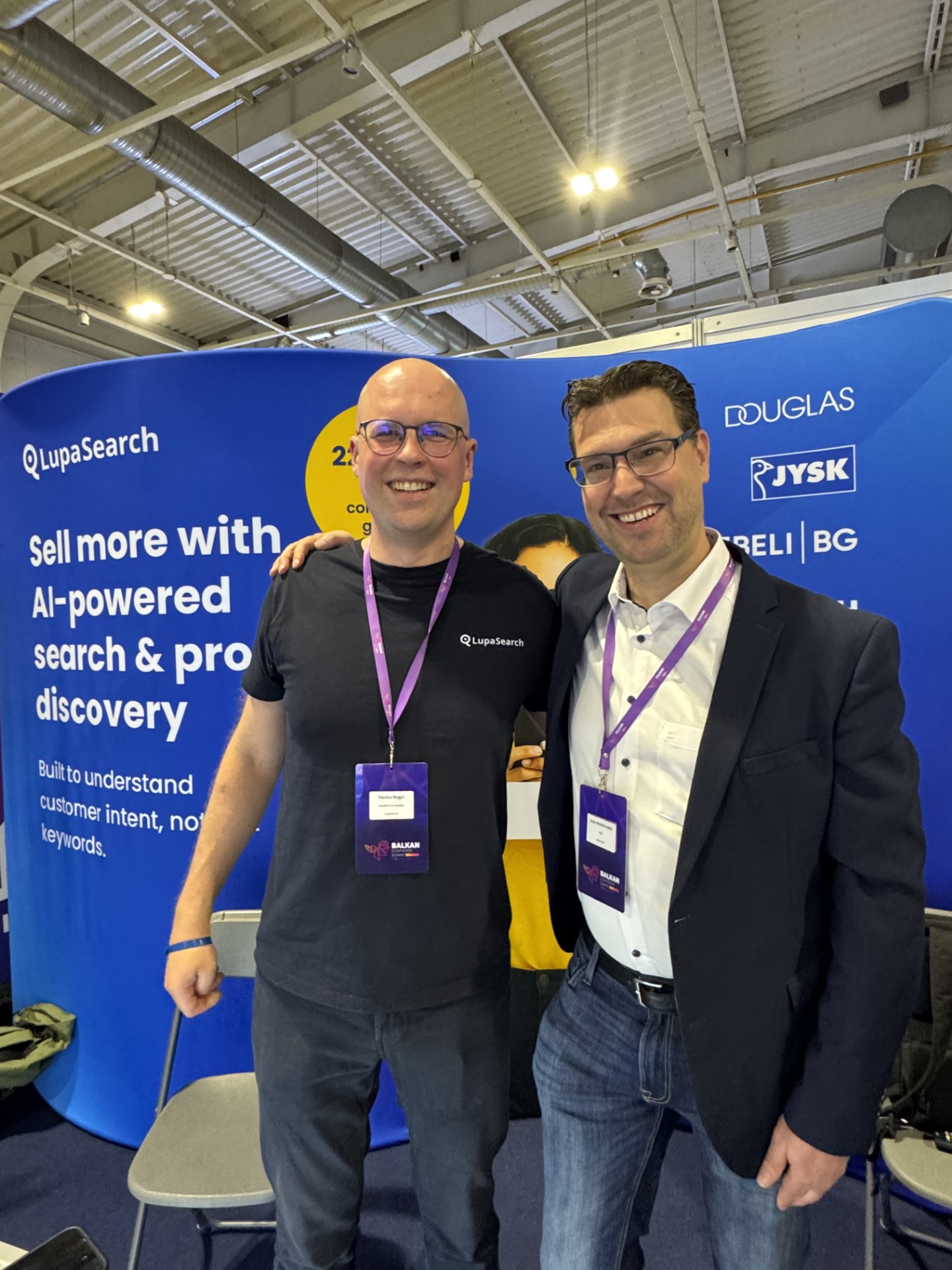
An interview with Paulius Nagys from LupaSearch on how AI is changing e-commerce search and product discovery. He explains why the search bar is still underestimated, why LLMs are not always the best answer, and why e-commerce companies need better data, better decision-making, and a more precise understanding of AI.
AI is rapidly entering e-commerce. It is used for content generation, personalization, customer service, recommendations, product data enrichment, and many other applications, including increasingly also (visual) search and product discovery.
But according to Paulius Nagys from LupaSearch, the real question is not whether e-commerce companies should use AI. The more important question is where AI actually creates value, and where it mainly adds cost, complexity, or hype.
For him, search is one of the most important and still underused areas in e-commerce.
“Many businesses are sitting on a gold mine and they don’t understand it.”
That gold mine is the search bar.
The search bar as the biggest feedback form
Paulius has been working in e-commerce for almost twenty years. Before LupaSearch, he worked in the Magento ecosystem and ran an e-commerce solution agency. The motivation to build LupaSearch came during COVID, when online traffic suddenly exploded and many webshops had to deal with much higher pressure on their systems.
“We noticed some weak points. And a major weak point was the search bar.”
For Paulius, that moment changed how he looked at ecommerce search. Many companies still treated it as a basic technical feature, while in reality it played a much bigger role in understanding customer behaviour and intent.
“It was a eureka moment for me, because I realized that it’s a weak point.”
The issue was not only technical. According to him, companies were also underestimating the strategic value of search data itself.
“The search bar is the biggest feedback form.”
Every query tells something about customer intent. What people search for, what they cannot find, which words they use, and where they leave the site all provide direct insight into demand. Yet many merchants still do not use that information properly.
“Many visitors are coming and leaving traces over there. You can collect all this data and see very clearly what is happening with your e-commerce store and with your visitors.”
Search, in that sense, is not just a navigation tool. It is a source of commercial intelligence.
Why basic search is no longer enough
A common mistake, Paulius argues, is that companies still understand search as a basic technical feature.
“Many businesses still understand search as Elasticsearch. It is auto-suggest, auto-correct, auto-complete.”
Those features matter, but they are no longer enough.
“That is hygiene. It is very basic stuff.”
For modern e-commerce companies, search can connect many more data points. Inventory, profitability, seasonality, margin, customer behaviour, and commercial priorities can all influence which products should appear and in what order.
He gives a simple example. If a customer searches for “Samsung”, the intent is not immediately clear. The customer could be looking for a phone, a television, a refrigerator, or a vacuum cleaner. The right answer depends on context.
If a football championship is coming up, the retailer may want to prioritize televisions. If inventory is high for a certain category, that may also matter. If commercial teams already know what needs to move, search should be connected to that knowledge.
“You just need to connect your commercial people who are working with inventory and seasons to search software.”
For Paulius, this is not always about AI in the narrow sense.
“I wouldn’t say that it’s an AI thing. It’s just business practice when you connect dots.”
That is an important distinction. AI can improve search, but the foundation is often more basic: better data flows, better business logic, and better integration between teams and systems.
From search to product discovery
Search is only one part of what LupaSearch focuses on. The company increasingly positions itself around the broader concept of product discovery. That distinction matters.
“Product discovery is a general term. It is how you bring results to your customer.”
Product discovery includes search, but also recommendations, personalization, merchandising, and other ways of helping customers find products. Search is often user-driven. Product discovery adds a stronger business layer.
Paulius explains this with a retail example. Suppose a merchant sells both Nike and Adidas trousers, but has better commercial terms with Nike. If someone searches for trousers, the retailer may want to show Nike products more prominently.
“If it is a plain search, then the user is controlling your search results. But if you have a merchandising engine, it brings your business into the search.”
This is not unusual in physical retail. Sales assistants often know which brands, products, or promotions should receive more attention. According to Paulius, the same commercial logic should also be built into ecommerce search.
“The whole commercial world is built on this. Search should also include those rules and functions.”
Yet, according to Paulius, only a minority of businesses use these possibilities well.
Where AI becomes valuable
AI-powered product discovery becomes especially relevant when companies have large product catalogs, weak product descriptions, or complex customer intent.
One example is visual search.
Paulius refers to CLIP, an open-source algorithm originally developed by OpenAI, which can connect images and text. For fashion retailers, this can be highly valuable. Product descriptions are often incomplete, while product images contain much richer information.
“If a fashion store has a huge catalog and weak product descriptions, but very high-resolution photos, then with an AI algorithm we can scan information out of the picture.”
A dress may have a flower pattern, even if that is not written in the description. A customer may search for that pattern, but traditional keyword search will not find it if the text is missing.
“It is not written that this dress is with a flower pattern, but in the picture there are flowers.”
That is where AI can create clear value. It can read signals that were previously difficult to use in search and discovery.
For Paulius, this is one of the positive sides of the current AI wave. Many technologies that used to be expensive or inaccessible are now easier to use.
“This AI era created really cool technologies which are open source and we can use them for search.”
The problem is not AI itself. The problem is assuming that every AI use case should be solved with large language models (LLMs).
Why LLMs are not always the answer
Paulius is optimistic about AI, but cautious about the current obsession with LLMs.
“Everyone is talking about AI. Businesses are in anxiety because they don’t know who speaks truth and who is creating hot air.”
He is especially cautious about using LLMs directly for search at scale. The issue is not only technical performance. It is also economics.
Some LupaSearch clients process tens of millions of search queries per month. If every query were sent to an LLM API, the cost would become enormous.

“It doesn’t work in economical terms. No one can afford that.”
That does not mean LLMs have no role. Paulius sees value in using them for specific components, such as synonym databases or language graphs. Before LLMs, companies often needed language specialists or teams to maintain these systems manually. LLMs can make parts of that process more efficient.
“You can use LLMs to create synonym databases.”
But he draws a clear line between using LLMs intelligently in the background and connecting every user query directly to a token-based model.
“I’m very cautious about direct tokenization.”
The broader question is whether the economics of LLM-based systems will work for high-volume e-commerce use cases. Paulius is not convinced yet.
“Everyone is talking about how amazing it is, but no one is profitable on that.”
This is one of the most important points in the interview. AI value in e-commerce is not only about model capability. It is also about cost, speed, scale, reliability, and integration into existing business processes.
Search queries are changing
At the same time, customer behaviour is changing. Paulius sees search queries becoming longer.
This is partly influenced by how people now interact with ChatGPT, Gemini, Claude, and other AI chatbots. Users are getting used to asking longer, more contextual questions.
“Queries are getting longer. When queries are getting longer, we can play a bit with this context.”
That creates new opportunities for search. With vector search and other AI-based methods, systems can better understand meaning, context, and similarity. This is different from simple keyword matching.
Paulius also expects voice search to improve significantly.
“I still believe that it is going to be a golden age in the future for voice search.”
Earlier voice systems often worked only partially. But as speech and language models improve across languages, voice-based product discovery may become more practical.
Still, he does not present this as a single technology shift. Search is becoming a puzzle of different algorithms and methods.
“It is a huge puzzle and there are really different algorithms.”

Analytics may be the most exciting part
Paulius is excited not only about better search results, but also about analytics.
LupaSearch collects large amounts of data about what customers search for, where they succeed, where they get zero results, which keywords are trending, and which are declining.
Traditionally, this kind of reporting could become overwhelming. It often produces raw data, but not always clear action points.
With AI, Paulius sees an opportunity to turn search data into more useful executive reports.
“Not raw data that you have this number of searches or this number of bounce rate or zero results, but action points.”
This is where AI can help translate behaviour into decisions. What should the merchant improve this month? Which product data is missing? Which categories are rising? Which queries produce no useful results? Which customer needs are not yet covered?
For e-commerce teams, this may be just as important as the search interface itself.
AI adoption in e-commerce is still early
When asked whether e-commerce businesses are using AI strategically, Paulius is cautious.
He sees many companies looking for “the smartest software company” rather than building a clear internal AI strategy.
“They are looking for the smartest guy in the room.”
This is understandable. Most merchants do not have large internal AI teams. They rely on software vendors to make sense of the landscape. But that also makes them vulnerable to marketing claims.
Paulius sees the market as still being at the beginning.
“We are at the very beginning.”
There are good experiments and promising case studies, but the real test is scale.
“Everyone is waiting for when it works in scale.”
That is where AI becomes more difficult. A tool may work in a demo. It may work for a limited use case. But when it is used in a large business with many automated processes, the requirements become stricter.
“You need precise decisions, precise software.”
This is also where hallucinations and error margins matter. In some contexts, a small error rate may be acceptable. In others, such as medicine, law, or pharma, it may not be.
“Some companies need to be precise.”
That does not make Paulius pessimistic. He is clear that many AI technologies are impressive and useful. But he also sees similarities with earlier hype cycles.
“Sometimes I am reading about the dotcom bubble in 2000, and I see too many similarities.”
Paulius is not skeptical about AI itself. His concern is whether companies apply the right technologies to the right problems.
The foundation is structured data
For companies that want to adopt AI tools successfully, Paulius sees one obstacle above all others: data.
“The biggest obstacle is structured data.”
Many companies have large volumes of data, but that data is fragmented, inconsistent, or unstructured. Without a better data foundation, AI systems cannot perform well.
That is especially important in e-commerce. Product titles, descriptions, attributes, images, categories, inventory, pricing, margins, and customer behaviour all need to be usable by the systems that depend on them.
But Paulius also stresses that technology is not the only issue. Decision-making itself needs to improve.
“There is a huge emotional layer in the decision process.”
AI can become almost religious in business discussions. If someone is impressed by a tool or a vendor, they may push adoption without enough analysis. Paulius warns against that.
“In business you need to be precise.”
He argues that companies should return to basic decision-making principles. What problem are we solving? What options do we have? What evidence supports the decision? What risks are involved? How will success be measured?
This may sound old-fashioned, but for Paulius that is exactly the point. The AI landscape is complex, so companies need more discipline, not less.
Why the AI vocabulary is still too vague
Another issue is language. Companies often talk about AI as if it were one thing. In reality, it refers to many different technologies, methods, and use cases.
Paulius illustrates this with a simple example. If people are asked to imagine a cat, everyone imagines something different. One person sees a white cat, another a big cat, another a small cat.
The same happens with AI.
“We have just one word and we imagine it differently.”
That creates confusion between companies, vendors, managers, and users. To make better decisions, Paulius argues, the industry needs a more precise vocabulary.
“We need to have more keywords, more vocabulary, not only those two letters.”
Instead of saying “AI”, companies should be clearer. Are they talking about vector search? Visual search? LLMs? Recommendation algorithms? Synonym generation? Voice search? Automated reporting? Image recognition?
That precision matters because different AI technologies have different strengths, weaknesses, costs, and risks.
AI and education
The conversation also moved to education and the way younger generations use LLMs.
Paulius is careful here. He does not pretend to have a simple answer.
“There is a saying that when conversation turns to education, it means that it’s almost the end of conversation. Because the toughest questions are in education.”
Still, he is concerned about students relying too much on LLMs before they have built their own knowledge.
“When you are an expert in your domain, then all these systems can definitely boost your efficiency.”
But the reverse is also true.
“If you are not an expert, it can be an awful mistake.”
For Paulius, LLMs are powerful accelerators for people who already understand a field. The more domain knowledge someone has, the better they can evaluate, question, and use the output.
But if students use LLMs before learning how to think, assess information, and build expertise, the tool may weaken the learning process.
“It doesn’t help them to learn.”
He recalls that university was once described to him as a place where you learn how to keep learning throughout life. That foundation remains essential.
“University educates you how you are going to learn all your life.”
In that sense, AI does not reduce the importance of expertise. It increases it.
The rise of niche experts
Paulius also expects AI to change what kind of expertise becomes valuable.
“I think the future is extremely niche experts.”
His own background was in management, a broad field that covers a bit of finance, marketing, math, and strategy. But with LLMs, people can go much deeper into specific niches.
“If you are an expert in a very niche field, you can explore that niche dramatically.”
This has implications for education, hiring, and professional development. General knowledge is still useful, but AI may reward people who combine deep domain expertise with the ability to use AI tools effectively.
Students and professionals may need to choose more specific areas of expertise and then use AI to go further within those areas.
Lithuania’s AI ecosystem
Paulius is optimistic about the Lithuanian AI and technology ecosystem.
“Yes, it is thriving.”
Lithuania is a small country, and according to Paulius, that creates pressure to move fast.
“When you are small, you need to be fast.”
He sees Lithuania as a tech-savvy country with a strong software development tradition. In earlier years, it was attractive for outsourcing. Over time, costs increased, but that also reflected a move toward higher value creation.
“We started to understand what impact we can create and what value we can gain.”
He points to Lithuania’s laser industry and other specialized technology sectors as examples of where the country already has strong capabilities. AI can then become a horizontal layer on top of those strengths.
“So we need to understand that AI is like electricity.”
No one says a refrigerator is “electricity-first”. Electricity is simply part of how everything works. Paulius believes AI should increasingly be understood in the same way.
“Let’s talk about the very niche domain where we are good at and how we put that horizontal layer on top.”
The challenge of talent and scale
The main constraint for Lithuania is not only AI talent. It is population.
“We are a small country.”
The economy is growing, and more people are needed to support that growth. Paulius sees this as a broader European challenge as well.
“Our economy is growing faster than we expected and we need more people to join that economy.”
Government support exists, especially through European funds and export support, but Paulius does not expect government to solve AI for companies.
“As a company, we don’t expect that government will solve AI stuff. Companies need to solve it.”
Still, if he were responsible for digitalization policy, he would create stronger bridges between technology companies and government.
“More synergies between government and technological companies.”
He argues that companies often have valuable knowledge about innovation, but there is no easy channel to bring that knowledge into government.
“I don’t have a bridge to talk with the government, the right bridge.”
Agentic AI and the psychology of control
Paulius is also critical of some of the current enthusiasm around agentic AI, especially when it is framed as fully autonomous systems operating with minimal human involvement.
His concern is not only technical. It is psychological.
“We are evaluating technology, but we are not evaluating psychology.”
“Humans like control, but they don’t like to be controlled.”
That creates tension around autonomous AI agents. People may want systems that make them more efficient, but they may not want those systems to take over important decisions completely.
“I really enjoy that they make me efficient, but I still would like to have control.”
He gives a simple example: payments. He wants AI to help, but he still wants to approve the payment himself.
“I would like to approve my payments. I don’t want robots or bots or agents to do it instead of me.”
For Paulius, this does not mean agentic AI has no future. It means that human nature should not be ignored. The future of AI systems will not only depend on what the technology can do, but also on what people are willing to delegate.
Advice for AI founders
When asked what advice he would give to entrepreneurs who want to build an AI startup, Paulius gives a direct answer.
“Ask at least 100 questions to 100 different people.”
Before building, founders need to understand the problem deeply. Startups exist because there is a problem and someone creates a solution that delivers value.
“Startups are about solving problems.”
That sounds simple, but Paulius believes many entrepreneurs skip this first step. They start from an idea rather than from enough conversations with potential customers.
“If you have an idea in your head, you need to have proof of concept. But before that, you need to talk with many people.”
LupaSearch still works this way. The company is constantly talking with clients to understand what problems they face and how the product should evolve.
“We are constantly in touch with clients and we are all the time trying to figure out how we can help them more.”
That is also how search became product discovery. Customers had broader problems than search alone, and the product evolved accordingly.
Enjoy the process, but stay precise
At the end of the conversation, Paulius returned to a more personal point.
“You need to enjoy the process.”
For him, this is a daily mantra. No one knows what the world will look like in 2040. No one knows exactly how AI, e-commerce, robotics, and digital infrastructure will develop. That uncertainty makes it even more important to enjoy the work itself.
“If you are enjoying it, you won’t regret it.”
But enjoyment does not mean naivety. Throughout the interview, Paulius makes a consistent argument: AI is useful, powerful, and full of opportunity, but e-commerce companies need to be more precise in how they use it.
The search bar is not just a search bar. It is a feedback form, a source of customer intent, and a commercial decision layer. Product discovery is not just about showing results. It is about connecting customer behaviour, product data, inventory, margins, and business priorities.
AI can help with that. But not every problem requires an LLM. Not every demo works at scale. Not every impressive tool makes economic sense.
That is perhaps the most important lesson from Paulius’ perspective. The real challenge is not simply adopting AI, but understanding which technologies solve real problems and still work reliably at scale.
Still, Paulius does not approach AI with pessimism. Throughout the conversation, he repeatedly emphasized curiosity, experimentation, and enjoying the process of building.
“Sometimes we are too serious. I think it is just a game. It is supposed to be fun.”
Then, laughing, he adds one final remark:
“Fingers crossed that we won’t end up with a Terminator movie.”
About Paulius
Paulius Nagys is the Co-Founder of LupaSearch, an AI-first search and product discovery platform designed to improve how customers find products online and help ecommerce companies increase conversions.
With nearly two decades of experience in ecommerce and digital products, he has worked on building and scaling technology ventures for international markets. Today, his focus is on advancing ecommerce search beyond traditional keyword-based systems toward AI-driven intent prediction and more intelligent product discovery.