

AI in E-commerce: From Practical Use Cases to Strategic Questions
Written by Jesse Weltevreden
An analysis of how AI is currently applied in e-commerce, based on insights from the Balkan Ecommerce Summit 2026. The article combines practical use cases with a critical perspective on strategy, measurement, and emerging developments such as agentic AI.
At the Balkan Ecommerce Summit in Sofia, Bulgaria, held on 28-29 April 2026, AI was not a side topic. It was the topic of almost every session I attended during the two days. But it did not appear as one coherent story. Instead, multiple narratives and viewpoints were presented.
Some speakers focused on visibility in AI-generated summaries, such as Google AI Overviews, and in major AI chatbots. Others on agentic AI and the future of transactions. Several sessions explored search, recommendations, and personalization. And many showed concrete AI applications for content creation, product page optimization, and campaign development.
Taken together, these sessions provide a clear picture of where the e-commerce industry in Bulgaria and the wider Balkan region currently stands with regard to AI. The focus of the talks was practical, commercially oriented, and clearly beyond the early hype phase. At the same time, the deeper implications of AI for market structure, competition, and strategy were only touched upon to a limited extent.
Visibility in the age of AI: from ranking to being selected
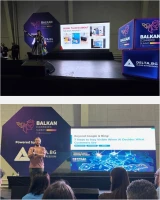
A large part of the program focused on visibility beyond traditional search. This was most explicit in Barbara Slade Jagodić’s session Get Visible Beyond Google: Search Everywhere Optimization for Google and ChatGPT and Gennadiy Vorobyov’s session Beyond Google and Bing: 7 Steps to Stay Visible When AI Decides What Customers See.
The core idea across these presentations is clear. Being visible in traditional search engine results is no longer sufficient. Brands increasingly need to be present in AI-generated summaries, such as Google AI Overviews and Bing Generative Search, and in major AI chatbots like ChatGPT, Google Gemini, Claude, and DeepSeek.
In his presentation, Gennadiy Vorobyov translated this into a structured approach. He framed the shift from SEO to GEO as a move from ranking links to being present in AI-generated answers. As he stated on one of his slides: “If you are not part of the synthesized answer, you do not exist for the customer.”
Although both presenters approach the topic from different angles, there is a high overlap in their recommendations. In practice, this comes down to writing clear and concrete content, structuring information so it can be extracted by AI systems, and building external credibility through mentions and PR. This also means being very clear about what you are offering. If the user is trying to understand something, explain it in a straightforward way. If the user is trying to buy, show concrete product information, comparisons, and what you actually sell.
Both speakers emphasized that information should be presented directly and clearly, instead of being hidden in long descriptive texts. In addition, Vorobyov explicitly warned that large volumes of generic AI-generated content without human editing do not work.
A second shared point is that visibility is no longer determined by the website alone. Both speakers stressed the importance of external signals. Mentions in authoritative media, presence on relevant platforms, and consistent brand representation across sources all influence whether a brand is recognized by AI systems. Digital PR, influencer collaborations, and being part of ongoing conversations were presented as central mechanisms to build that visibility. In that sense, brand mentions are becoming the new backlinks.
These perspectives strongly align with the GEO and AIO principles I discussed in my keynote. At the same time, I would nuance how this shift is often described. It is not simply a move from many options to a single selected answer. In traditional search, users were already highly selective and often did not look beyond the first few results.
What is changing is the interface and the way results are presented. Instead of scanning a list of links, users interact with answers in natural language. That creates new opportunities for brands to be included in responses to a wider range of questions, not only for a limited set of keywords.
At the same time, this also makes visibility much harder to assess. One of the cases presented in Vorobyov’s session did not appear when I asked the same question in ChatGPT myself. This suggests that AI-generated answers are not stable or uniform. In chatbots, answers depend on factors such as the user’s context, prior interactions, and location. For example, if I ask ChatGPT about the top AI tools directories, it will mention RankmyAI. But this is not always the case for users who do not know RankmyAI. Even within the same country, different users may receive different recommendations.
A second issue is measurement. With AI answers in search engines, the logic is still relatively close to SEO: users enter queries, search volume can be estimated, and tools can track which queries trigger AI Overviews. With chatbots this is much less clear. We do not know which prompts users enter, how often they occur, or which ones actually lead to traffic. In practice, this means that prompt tracking is useful, but mostly directional. It can show whether a brand appears more often in a selected set of prompts, but it does not provide the same certainty as keyword tracking in traditional SEO.
This also means that we should be careful with strong claims about AI visibility. Referral traffic from chatbots can be measured, and growth in that traffic may indicate that GEO efforts are working. But the prompts behind that traffic are often unknown. So the main question is not only whether a brand appears in AI answers, but whether we are tracking the right prompts in the first place. For e-commerce companies, this requires a critical and cautious approach to the added value of AI visibility tools.
While the tips presented in these sessions help, including those in my own keynote, I am not yet convinced that they (always) guarantee broad visibility. They are a good starting point, but visibility in chatbots is more fragmented, more personalized, and harder to measure than traditional search visibility.
Agentic AI: a future that is already shaping the present
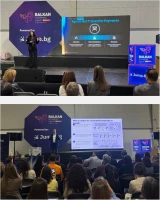
A second theme that appeared in multiple sessions is agentic AI. Petya Rusinova from Visa explicitly addressed this in her presentation Agentic AI – The Shopping Revolution, and the topic also appeared in my keynote.
The idea behind agentic AI is straightforward. Instead of users searching, comparing, and deciding, they delegate tasks to AI systems that act on their behalf. In my keynote, I framed this as a shift from recommendation to execution, from browsing to task completion, and from discovery to transaction.
Visa’s presentation supported this direction and presented it as a logical next step in digital commerce. At the same time, it also made clear that there are still fundamental challenges. From a merchant perspective, the question is whether a transaction initiated by an agent can be trusted and whether payment is guaranteed. From a regulatory perspective, the key issue is whether there is a verified customer behind the transaction. The solutions presented by Visa address these challenges, but still rely heavily on human involvement, for example in selecting options and authorizing payments.
This already shows that while the direction is clear, current implementations are not fully autonomous. Human intervention remains an essential part of the process.
That gap between vision and practice becomes even clearer when looking at other perspectives shared during the event.
Tudor Goicea questioned how far agentic AI will develop in practice, noting that it is still unclear whether consumers will adopt fully autonomous agents at scale. He also distinguished between agents operating through major platforms and assistants embedded in a company’s own website, and raised the question to what extent these can be considered truly autonomous.
Paulius Nagys added another perspective by focusing on bots that access e-commerce websites. He showed that these bots already search, retrieve information such as prices, and interact with websites, but that companies need to actively manage them by facilitating legitimate bots and blocking unwanted ones. He stressed that although these bots are not yet fully agentic, they are already here.
Taken together, these perspectives point in the same direction. The idea of agentic AI is widely discussed and clearly shaping how companies think about the future of commerce. At the same time, current implementations still involve significant control, constraints, and human oversight.
For e-commerce companies, the point is not to wait for full agentic AI, which may or may not happen, but to start preparing for this transition. A large part of that preparation overlaps with what was discussed in the previous section on Visibility in AI, especially structuring data and improving visibility. At the same time, it requires additional steps, including making systems accessible for machine-to-machine interaction through APIs and emerging protocols such as agent-to-agent (A2A) and agent-to-platform (A2P).
On-site search is evolving, not disappearing
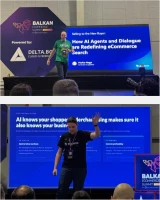
On-site search was another central topic, particularly in the presentations by Tudor Goicea from Aqurate, Search, Recommend, Reward: How AI Personalization Converts Visitors into High-LTV Shoppers, and Paulius Nagys from LupaSearch, Selling to the New Buyer: How AI Agents and Dialogue are Redefining eCommerce Search. Both started from a similar observation: traditional keyword-based search is no longer sufficient.
Paulius Nagys framed this as a shift from keywords to dialogue. Users no longer search for “blue shoes”, but describe what they need. Vector search enables systems to interpret meaning instead of matching words.
Tudor Goicea approached the same problem from a different angle. AI can analyze behavior and generate recommendations, but it does not understand business priorities by itself. This means that search and recommendation need to be guided by explicit rules, for example around margins, inventory, or campaign priorities.
Together, these perspectives highlight an important point. Search is not being replaced. It is being redefined. It becomes more semantic, more personalized, and more tightly connected to how companies manage their assortment, margins, and stock.
In that sense, the focus of both presentations was very much on what companies can do today within their own search and recommendation systems. This is about improving on-site search, moving from keyword matching to understanding intent, and combining that with explicit control through merchandising and business rules.
Scaling content and personalization: from experimentation to routine
Another theme that emerged across several presentations is the use of AI for content creation, personalization, and campaign execution, with a strong focus on practical implementation.
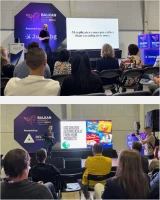
A recurring theme across these presentations is that personalization is becoming more important and, at the same time, easier to implement with AI.
Product pages are no longer fixed. AI is used to adapt content, images, and messaging to individual visitors, for example through personalized pop-ups, recommendations, and variations in product presentation. The underlying idea is straightforward: higher relevance leads to higher conversion rates.
In The Future of E-commerce CRO as the New Growth Engine, Krisztián Király of OptiMonk showed how AI is used to optimize product pages and run A/B tests at scale. Instead of testing a limited number of variants, AI enables continuous experimentation across many elements at once. At the same time, this raises a question that was not addressed: do these results hold in the long run, not only for the customer base of a single company, but also when many companies start applying similar techniques?
Krystian Wydro of OtterMind, in Scaling Creative Production with AI, focused on generating images and video campaigns, enabling rapid content production across channels. This makes it possible to create variations for different audiences and moments without the traditional constraints of time and resources. Sar Zvuluni and Kobi Haddad from Sellavi, in The AI Innovation in E-commerce, presented a broad toolkit for SMEs, including AI-driven pricing, ad generation, product creation, and even building online stores directly from social media content.
Taken together, these presentations show that AI is already embedded in many day-to-day activities in e-commerce. AI-driven content creation, personalization, and campaign execution are not yet mainstream across e-commerce companies, but the examples showed that they can already be implemented at scale today.
At the same time, Harri Olavinsilta, in From Data to Desire: Building E-commerce Brands With AI, offered an important counterbalance. If AI is mainly used to scale existing formats, the result is often more of the same. The challenge is not only to produce more content, but to maintain distinctiveness. His emphasis on cultural relevance highlights a dimension that is often overlooked in more execution-driven approaches.
This creates a clear tension. On the one hand, AI enables scale, speed, and personalization at a level that was previously not possible. On the other hand, it increases the risk that everything starts to look the same.
A missing layer: strategy, structure, and limits
Across these sessions, the focus was primarily on what AI can do, how to implement it, and how to prepare for a world in which AI becomes more dominant in search and beyond. Many presenters showed concrete use cases, tools, and results. What received much less attention is where AI actually creates value, how it affects competition, and what its limits are.
In my keynote, I emphasized that while the number of AI tools continues to grow, usage remains highly concentrated. A small number of platforms capture a large share of traffic and investment. This has direct implications for e-commerce companies. It affects where customers discover products, which intermediaries gain power, and how dependent companies become on a limited set of platforms.
A second point that remained underdeveloped is measurement. Many examples showed improvements in conversion, engagement, or efficiency. But it remains unclear how robust these results are. Do they hold over time? Do they still work when many companies apply similar techniques? And how should companies measure success when interactions increasingly take place through AI systems rather than traditional interfaces?
There is also a risk of focusing too much on generative AI alone. Many of the examples presented rely on generative AI across different layers, from content creation to AI-generated answers in search, and chatbot interactions. While these are relevant, they are only part of a broader set of AI applications. Core processes such as search, recommendation, pricing, and operations remain equally important, and more traditional forms of AI can add significant value here, for example through recommendation algorithms, demand forecasting, dynamic pricing, and inventory optimization, but these received less attention during the event.
A final observation is the large exhibition area, where a wide range of companies presented themselves to e-commerce businesses, including e-commerce suppliers, agencies, financial service providers, and many AI companies. This created the opportunity to connect directly with founders and teams behind these solutions, including Todor Terziev from Zenterra AI, Simeon Lukov and Mikhail Stoyanov from Dynamic Pricing AI, Krisztián Király of OptiMonk, and Paulius Nagys from LupaSearch. It provided a concrete view of how much innovation is currently taking place, both in the Balkan region and beyond, particularly in the field of AI. Many of these companies are developing promising solutions that can support e-commerce businesses in areas such as marketing, operations, and customer experience.
For e-commerce companies, it is important to take a balanced and selective approach to AI. Start from strategy and expected ROI, not from hype or by blindly following competitors. Focus first on what can be implemented today, such as improving visibility in AI-driven environments, strengthening on-site search and recommendation, and applying AI in content and personalization where it adds clear value. At the same time, remain critical about measurement and cautious about overreliance on tools and platforms.

Although AI can add significant value across many parts of the business, it also makes running an e-commerce company more complex, with new technologies, shifting channels, and changing customer expectations to manage. Events such as the Balkan Ecommerce Summit help to structure this discussion: where the market is heading, what already works in practice, what does not, and how prepared e-commerce companies are to implement AI and take concrete next steps.


