

OpenAI’s new business feature: a death blow to AI visibility trackers?
Written by Jesse Weltevreden
OpenAI’s new Business Hub gives companies statistics based on actual ChatGPT use, reducing the added value of paid AI visibility trackers. Referral traffic data and the difficulty of reproducing personalised recommendations raise further questions about what businesses gain from these services.
OpenAI now allows businesses to manage their company information in ChatGPT and access statistics on website references and clicks. For providers selling AI visibility tracking, this creates direct competition. What should businesses pay to estimate if they can obtain usage statistics from ChatGPT itself?
On 10 November 2026, OpenAI introduced Businesses in ChatGPT. Through Business Hub, companies can claim their business, update their information and access engagement statistics. Eligible businesses can also create a Business Agent to answer customer questions.
Many answer engine optimisation (AEO) and generative engine optimisation (GEO) providers sell tools that track whether companies appear in answers from ChatGPT and other AI chatbots/LLMs. They typically ask selected questions repeatedly and calculate how frequently a company appears. Business Hub gives companies access to a different type of measurement: activity recorded during actual ChatGPT use.
What businesses can manage and measure
Business Hub allows companies to provide and update information such as their website, description and policies after verification. Companies selling products can also connect a product feed containing prices and availability.
For businesses that want to understand how they appear in ChatGPT, Business Hub also provides engagement statistics. Companies can see how often they are mentioned and how often users click through to their website. For online businesses, a mention only counts when ChatGPT references the company’s website; naming the brand alone does not count. Companies can also explore “discovery topics”, which group the themes of answers in which the business appears. These figures are aggregated. Businesses cannot see individual customer questions or conversations, and statistics are only available when minimum reporting thresholds are met.
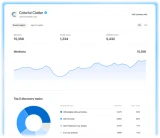
Business Agents allow customers to start a separate conversation with a business about its products and policies. These conversations are labelled and distinguished from ChatGPT’s independent answers. At launch, Business Agents are available to eligible e-commerce and online service businesses in the United States.
Companies do not need to advertise to use Business Hub. Managing business information, connecting product feeds and accessing available statistics are separate from ChatGPT Ads. Businesses can use ChatGPT Ads to direct users to a conversation with their Business Agent.
The service is currently in beta. When we registered RankmyAI, we initially joined a waiting list but received access shortly afterwards. Getting access was quick; claiming and verifying the business proved more complicated. Companies can start the registration process through OpenAI’s Businesses in ChatGPT page. Claiming a business does not guarantee more recommendations. Companies can manage the information they provide, but they cannot control ChatGPT’s independent answers. Bloomberry lists companies already registered with ChatGPT Business Hub.
ChatGPT is the largest AI chatbot
According to OpenAI, 1.2 billion people now use ChatGPT each week. Our analysis of Similarweb data shows that monthly website visits to the AI chatbots analysed increased more than fivefold between August 2023 and August 2026, reaching almost 10 billion.
ChatGPT accounted for 57% of visits in August 2026, followed by Google Gemini with 26% and Claude with 10%. Compared with August 2025, visits to ChatGPT fell by 4.8%, while Gemini grew by 261.3% and Claude by 549.2%. DeepSeek grew by 10.8%, while Microsoft Copilot recorded a decline of 23.4%.
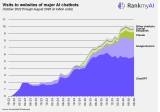
These figures count website visits, including repeat visits, rather than individual users. They exclude usage through apps and other software. This matters particularly for Copilot, which is also used within Microsoft applications. Fewer visits to its website do not necessarily mean that fewer people use Copilot.
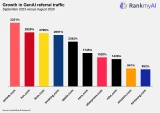
Website visits measure traffic to the chatbots themselves. For businesses, we also examined referral traffic: visits to their websites by users who click on a link in an AI chatbot’s answer.
We selected ten international consumer websites as an illustrative sample covering several sectors: Amazon, AliExpress, Booking.com, Airbnb, IKEA, Apple, Samsung, Nike, H&M and Zara. Similarweb data show that AI chatbot referrals grew by between 892% and 3,331% from October 2023 to August 2026.
The growth appears exponential, but in August 2026 these referrals still accounted for less than 1% of total visits to eight of the ten websites. Only Samsung and Apple exceeded that level, at 1.24% and 2.50%, respectively.
Our analysis of other businesses and websites shows that these shares can vary widely by product and sector. However, AI referrals generally accounted for less than 2% of total website visits in August 2026, with some exceptions. These figures exclude consumers who discover a business through AI and later visit it directly or buy through another channel.

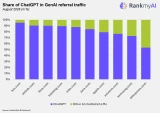
ChatGPT dominates GenAI referral traffic
ChatGPT accounted for the majority of AI chatbot referrals to all ten websites in August 2026. Its share ranged from 53% for AliExpress to 95% for H&M. For six websites, it exceeded 80%.
For the businesses analysed, ChatGPT is the main chatbot to monitor. Other AI chatbots/LLMs generate a much smaller share of referrals, which already limits the value of paying for visibility trackers to monitor them. Now that ChatGPT provides statistics based on actual usage, the added value of these trackers decreases further. The differences between websites still matter. Other AI chatbots/LLMs together generated 47% of AI referrals to AliExpress. Businesses should assess their importance using their own traffic and audience data.
Tracking 100 questions does not reproduce customer conversations
My main criticism of AI visibility trackers concerns the relationship between their tests and what customers actually see.
A provider can run 100 company-related questions through an API, an automated connection to an AI chatbot/LLM, and calculate how frequently a brand appears. The result describes answers to those questions under those testing conditions. It does not establish how frequently the brand appears in real customer conversations.
Before asking for a recommendation, a customer may have discussed their budget, requirements and preferences. They may have rejected certain brands, described a previous purchase or specified where a product needs to be delivered.
Two people asking “Which laptop should I buy?” may therefore receive different recommendations. One may have already explained that they travel frequently, edit videos and have a budget of €2,000. The other may need an inexpensive laptop for their child.
A tracker asking the question separately does not reproduce the preceding conversation. Adding details can make the test more specific, but the provider still needs evidence that the selected situations reflect those of actual customers.
Personal history and location influence recommendations
Depending on the settings, ChatGPT can build up a history and a user profile across conversations. When someone starts a new conversation, ChatGPT may already know that person’s interests, needs and preferences. This information can influence which businesses or products ChatGPT recommends, even when those preferences are not mentioned in the new conversation.
A standard API test does not include the same personal history as a customer’s account. The tracker and the customer can therefore ask an identical question while providing ChatGPT with different information.
ChatGPT can use information about a user’s location when recommending businesses and brands, even when no location is mentioned in the question. Someone in London may therefore receive different recommendations from someone in Singapore asking exactly the same question. These differences also occur within countries, between cities and towns. This makes it difficult for visibility trackers to reproduce the recommendations users receive in different locations.
Brand recommendations change between responses
What’s more, when the same question is repeated, the brands recommended, their order and the number of recommendations can change significantly. Research published by SparkToro found this variation across thousands of responses from ChatGPT, Claude and Google’s AI services.
The researchers concluded that measuring how frequently a brand appears across repeated questions could provide useful information. They found much less support for treating its position in an answer as a stable ranking.
Repeated testing can therefore help establish how frequently a company appears for a selected question. It does not establish how often customers ask that question, which information they share beforehand or how personalisation affects their answers.
A 30% visibility score describes the tracker’s test responses. It does not show how often the company appears in answers to relevant questions from actual users, the activity that Business Hub’s statistics are based on.
Implications for AEO and GEO providers
For companies selling visibility tracking, including providers listed in our RankmyAI ranking of AEO and GEO optimisation tools, Business Hub puts pressure on the value of a separate tracking subscription. Businesses have less reason to pay for estimates of their ChatGPT presence when OpenAI provides statistics based on actual usage.
Many providers also offer content optimisation services. They help businesses improve website content and product information so that AI chatbots/LLMs can find and use it in their answers. These services can remain relevant. However, a higher score in the provider’s own AI visibility tests does not prove that the company is recommended more often to actual customers or receives more website visits, enquiries or sales.
Competitor monitoring is another service, but it has the same measurement problems discussed above. Providers can compare which companies appear in answers to selected questions. They cannot establish from those tests how frequently competitors are recommended in real customer conversations. Business Hub does not resolve this gap either, as it provides statistics for the business being managed, rather than equivalent data for its competitors.
Providers focused mainly on AI visibility tracking therefore face more pressure than those offering content optimisation and other services. OpenAI can expand Business Hub with statistics and features that businesses currently pay external providers for. Other AI chatbot/LLM providers could do the same, reducing the need for separate tracking subscriptions.
Would I recommend paying for an AI visibility tracker?
I was already sceptical about AI visibility trackers because of the problems with context, personalisation, location and inconsistent recommendations. OpenAI’s new statistics give me even less reason to recommend them.
For the websites analysed, ChatGPT is also the largest source of AI referrals. That makes its own reporting particularly relevant and weakens the argument for paying primarily to monitor other AI chatbots/LLMs.
This also shows how quickly the AI market changes. AI visibility tracking providers grew rapidly in 2025, and only a year later, OpenAI is already threatening part of their business model by offering its own statistics.
My advice to businesses is to start with the available ChatGPT statistics, examine referral traffic and assess the contribution to enquiries, sales or other relevant results. Before paying for an external tracker, ask what it tells you beyond ChatGPT’s own statistics and what evidence shows that its AI visibility scores reflect the recommendations actual customers receive.
Whether Business Hub becomes a death blow to visibility trackers remains to be seen. For providers that mainly run a selected set of questions through AI chatbots/LLMs and report how often a company appears in the answers, I see increasingly little reason to pay.
Other articles
-

AI Product Image Generators: The Most Popular Solutions Reshaping E-Commerce Visuals
-

5 New AI Tools: From the dentist's front desk to the law firm's intake
-

Persona Development: The Most Popular AI Tools for Building Your Ideal Customer
-

Behind the scenes: Better search, ranking history and faster tool listings